Using Ram Dass’s Teaching on Separateness to Explain the Whole Darn Spiritual Path
A summation of everything I’ve learned.
Here’s how I look at studying the macro matters of the metaphysical.
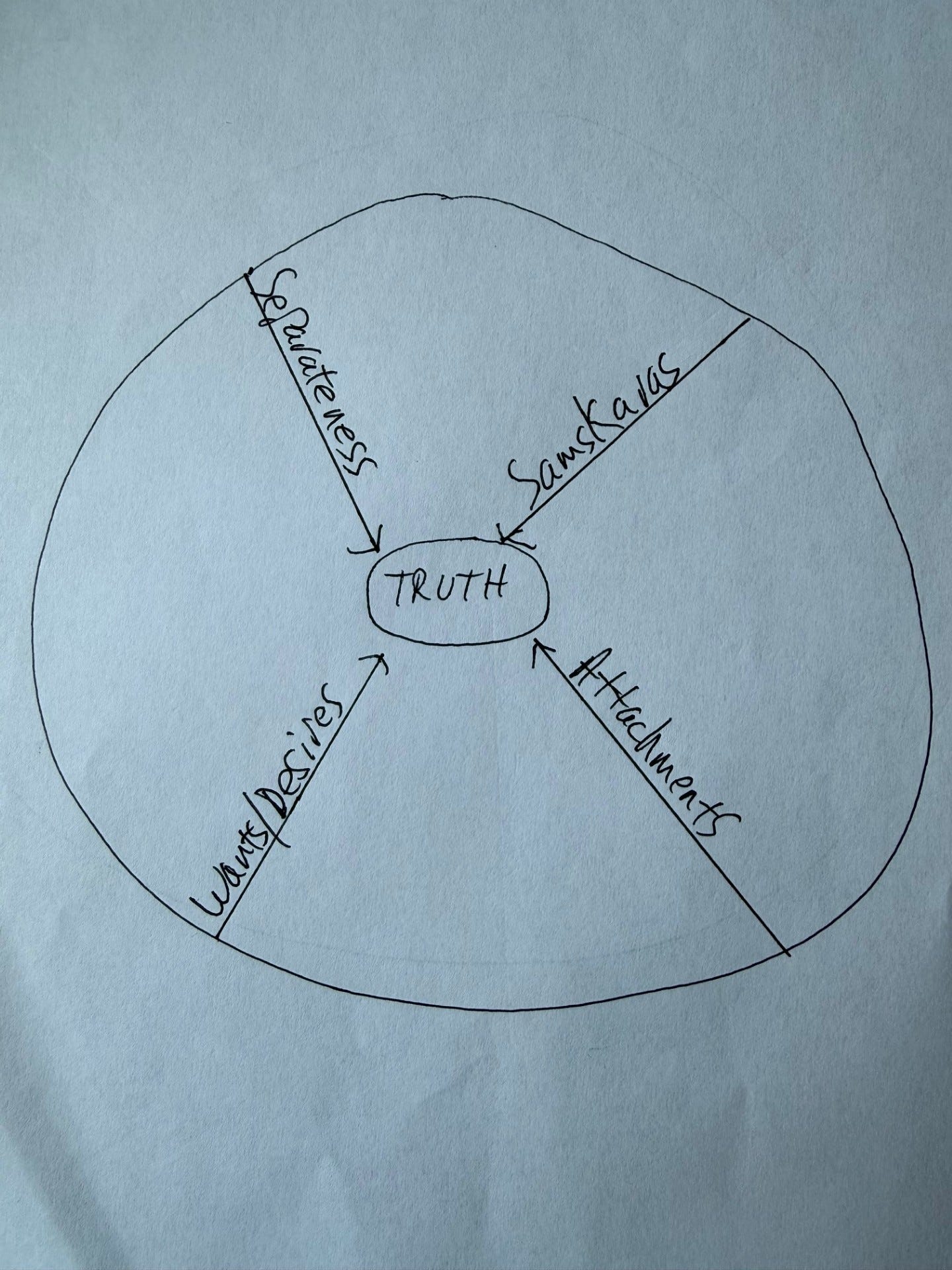
Imagine a circle. At its center is another, smaller circle.
The circle of truth
That small circle is the absolute truth of the human condition. And from several points on the bigger circle, we can draw a line to the smaller circle of truth.
What those lines represent are different ways of illuminating this same macro truth. What are some of those ways?
-Our problems/suffering in life stem from wanting things to be a certain way, AKA desire in the Four Noble Truths of Buddhism. Our egos are the source of those wants. Eliminate the ego and the wants go away…and so does the suffering.
-The ego causes us to create attachments, which are the chief source of suffering. Remove the attachments and we eliminate the suffering.
-In Michael Singer’s Yoga-based teachings, we have experiences that we hold onto that become pockets of stuck energy called Samskaras. Those energies plague our lives until we let them go.
Well, there’s another paradigm through which to view the truth of human experience. It’s one that I’ve heard the great Ram Dass expound on several times. It’s captured in one word:
Separateness.
As in, most humans feel that they are a unique and separate entity traversing the Universe alone.
Eckhart’s ripple in the ocean metaphor
Eckhart Tolle uses the metaphor of the ripple in the vast ocean to illuminate the concept.
If you are a ripple cruising along the surface of the Atlantic Ocean and you think that’s all you are – just one lonely ripple fending for itself in that turbulent, immensity of water – well, that’s a scary existence of fear, contraction and anxiety.
If, on the other hand, you realize that you are not separate from, but are intimately connected to and a part of the ocean, the fear isn’t there.
As Rumi described it:
“You are not a drop in the ocean. You are the entire ocean, in a drop.”
Carrying this metaphor to we humans, if we aren’t a completely separate, lonely being/drop in the ocean, then what are we? First, we need to know, what is the ocean in our example?
The ocean equates to the consciousness of the Universe. And consciousness is consciousness. It’s all the same.
What we all get when we come into the world as form/humanness is a little slice of that universal consciousness.
[Quick digression/timeout here. My head is about to explode just writing this. If yours is, too, hang in there! This is leading somewhere.]
A slice of universal consciousness
The Hindus call that slice the Atman. And the Atman is a little slice of Brahman, the ultimate reality and supreme divine force underpinning all existence.
That slice of Universal consciousness/Atman is the essence of who we are. It is perfect, beautiful and supremely loving.
So, what the heck happened? I don’t know about you, but I don’t feel perfect, beautiful and supremely loving all the time. How come?
The roles we play
Because I, like the rest of humankind, developed this thing called an ego starting from my earliest days. I was given a name and then a bunch of roles and identities to play.
Son. Athlete. Friend. Student. Employee. Boyfriend. Husband. Dad. Brother. Writer.
We all did that in furtherance of protecting ourselves from the big, bad world. We were told, in essence:
“Be a good son and we’ll love, feed and protect you.”
“Be a good athlete and we will shower you with praise and respect.”
“Be a good employee and I’ll give you a raise and a title that will make you feel more important.”
And on and on and on.
What all of these accumulations of ego did was move us further and further away from our perfect, slice of consciousness self. They also made us feel…
Separate.
Separate from what? That Brahman/Universal consciousness that we all are at our essence.
Roles played by David Gerken
I identify as David Gerken, husband, dad, tennis player, brother, Princeton grad, writer, funny guy and obnoxious smart ass, among other roles and traits.
What I don’t identify as is the slice of consciousness that is my true self.
What I’ve just laid out here, ladies and gentlemen, is one way of describing the central predicament of humanity: We identify as the ego-created separate being and not as our true, conscious selves.
What happens when we drop our egos? We lose that sense of separateness. And what takes the place of that separateness?
My favorite spiritual being, Neem Karoli Baba (the guru of Ram Dass), said and taught very little. But one thing he was said to say often was,
“Sub ek.”
In Hindi that means “All one.”
So that’s what takes the place of separateness when we drop the ego: A sense of oneness with the Universe. This feeling of being part of everything is the opposite of separateness.
Why this confuses people
Some people get confused by this, thinking,
“We’re all one? As in, one and the same? That’s crazy. Everybody on the planet is completely unique. Even identical twins.”
Which is true. Every human is distinct and unique.
The same consciousness expressing itself through us
So, what’s the deal? The deal is that this Universal consciousness, AKA God, the Source, the Creator, wants to express itself through all of these different forms/people that it created.
That consciousness expresses itself through me, a five-foot, ten-inch male, born into a particular family, etc., etc., different than it does through a woman born in rural China who works in an Apple factory making iPhones.
It’s the same consciousness experiencing the world through all the myriad forms it has created.
Where does this all leave us? What are we to take from this one expression of the overall truth?
We’re all one
First, and most obviously, I hope you’ll take to heart that you are not alone in this big, bad world, but are intimately connected to the whole. And because most of you probably don’t feel this way, you’ll need to begin by knowing this intellectually. That’s your starting point.
How do we actually get to a place where we feel and deeply realize this notion of sub ek/all one rather than just knowing it intellectually?
That brings us to takeaway number two. And it’s a big one. In fact, it’s the biggest one of all in our spiritual journey. It’s about that little circle of truth at the center of the big circle.
You’ll remember that we drew lines from different points on the big circle to little one in the center.
Lines to the center of the circle
Those lines represented different ways of expressing the big spiritual truth in the center. Summed up, those lines were:
-We suffer because we want/desire things to be a certain way. Remove the wants and the suffering ends.
-We create attachments which cause suffering. Remove the attachments and the suffering ends.
-We have experiences that we hold onto that manifest as energies known as Samskaras. Those energies are the cause of suffering. Let them go and the suffering ends.
And now we’ve added a fourth line/path to explaining the central predicament of humankind:
-Separateness causes suffering. Remove it and the suffering ends.
All four concepts are just different ways of getting to that central truth in the middle of the circle.
The central truth
What is that central truth? You all know it by now, but I’ll spell it out as clearly as possible.
Drumroll please…
Desires/wants, attachments, Samskaras and separateness are all created by the same entity:
The ego.
As such, here’s the human journey as I see it:
-We’re born with a slice of Atman/Universal consciousness that is beautiful and perfect.
-We develop an ego early on that obscures this consciousness and makes us feel separate and fearful.
-The work of the spiritual path lies in letting go of the ego so we can resume identifying as what we’ve always been – a beautiful, conscious being.
Final thoughts
After several years of studying, analyzing and traveling the spiritual path, that’s what I’ve come up with.
Who would’ve thought that Elsa, an animated character in Frozen, had the ultimate answer all along:
“Let it go!”


