

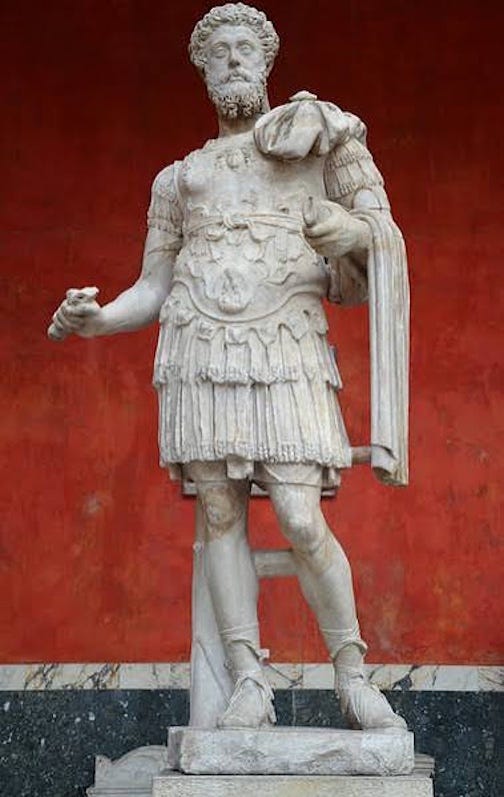
For a Roman emperor who lived almost 2,000 years ago, Marcus Aurelius sure does get a surprising amount of attention these days.
This is mostly because of his prominent place in the pantheon of Stoic philosophers, along with Epictetus, Seneca the Younger and Zeno of Citium.
What is Stoicism?
It’s a very cool philosophy that I wholeheartedly believe in. What is stoicism? This definition from AI seems as good as any:
A practical system of personal ethics teaching that inner peace and flourishing come from focusing exclusively on your own rational choices and virtuous actions while calmly accepting whatever external events lie outside your control.
My favorite example of Marcus Aurelius’s staying power in today’s world comes from the guy who created and starred in my favorite sitcom of all time: Jerry Seinfeld. Jerry recently told an interviewer that Meditations, Aurelius’s main text, had captivated him.
Seinfeld on Stoicism
Here’s how Jerry describes the Aurelian philosophy:
“Everything that you’re worried about is going to be gone like that. The people that are criticizing you, they’re going to be gone. You’re going to be gone. All this hand-wringing, worry, and concern over ‘How are people viewing me,’ ‘Someone said something bad about me’ — and you get so upset about it — is wasted time and energy. Your only focus should be on getting better at what you’re doing. Focus on what you’re doing, get better at what you’re doing. Everything else is a complete waste of time.”
Sounds good to me.
But I came across a Marcus Aurelius quote recently that blew me away even more than the above. Here it is:
“If you seek tranquillity, do less.”
Six words. A ton of wisdom.
I see two powerful takeaways from this for we modern humans.
Doing less doesn’t mean laziness
First, let’s address the obvious. By “do less” Marcus Aurelius didn’t mean that the road to inner peace lies in sitting on the couch watching Gunsmoke reruns while devouring an endless supply of Lay’s potato chips.
This was a decidedly unlazy guy who in his twenty years as emperor fended off several outside invaders and instituted landmark social and legal reforms all while finding the time to author, in Meditations, one of the greatest works of philosophy ever written.
What he did mean is that the path to serenity comes through simplicity. In all things.
Another way of putting it is that peace comes not from doing, doing, doing, but from being, being, being.
My Stoic mom
My mom unknowingly took this to heart in her life. This manifested as a fried egg on toast for breakfast, a brisk walk, some gardening and, of course, tending to the myriad needs of her six children. A happier, more peaceful person you’d never meet.
What this comes down to is needs and wants. Those who have a lot — wagyu steak only, the perfect shade of white for the kitchen walls, the finest of the finest sound systems for the house — will be hard-pressed to achieve equanimity. Those with few, like my mom, have a much easier path to tranquillity.
There’s a second piece of the Aurelius quote that also hit me. It has to do with work. How so?
Work: Do more by doing less
It has to do with how most people view performing work. They think, because they’ve been taught, that being busy, busy, busy is the way to go. Focus on just getting as much done as possible.
That is not the way to peak performance. What is the way?
As Marcus Aurelius said: Do less.
Zoom out, then zero in
By that I mean zoom out to the 30,000 foot macro view and determine the few truly important areas to focus on. This is what most successful workers do. It’s called working smart.
What I’m doing here is taking Aurelius’s quote and replacing ‘tranquility’ with ‘peak performance’ and ‘do less’ with ‘do fewer, but more important’ tasks. Tranquility begets peak performance when we focus on the important.
When we act as busybodies, we’re normally just allowing our overactive minds to run the show. We ‘do’ more, but accomplish less.
Not surprisingly, people prefer working ‘harder’ because it’s actually easier. Than what? Slowing our minds down so we can determine what we really need to focus on.
Covey’s four quadrants
The author and educator Stephen Covey expressed this most powerfully in his book First Things First. In it, he described the four quadrants of work tasks people encounter.
-Quadrant 1: Urgent and important.
-Quadrant 2: Not urgent and important.
-Quadrant 3: Urgent and not important.
-Quadrant 4: Not urgent and not important.
Obviously quadrants three and four are pointless.
The surprise is that he says we should organize our work lives such that we spend most of our time in quadrant two. It’s about focusing on planning and strategy over running around all day like chickens with our heads cut off.
Hope that all makes sense.
The takeaway
The bottom line is that Marcus Aurelius was right. Good things happen in life when we do less and simplify matters.
We perform better at work and, more important, we experience more peace, which, in my book, is the most important endeavor we humans can pursue.
Credit to Ryan Holiday for reviving Stoicism in these modern times as a revamp, sort of. Also -my mom had a fried egg on toast every morning. She raised 5 of us and was a very progressive thinker for her time.
Great Substack article