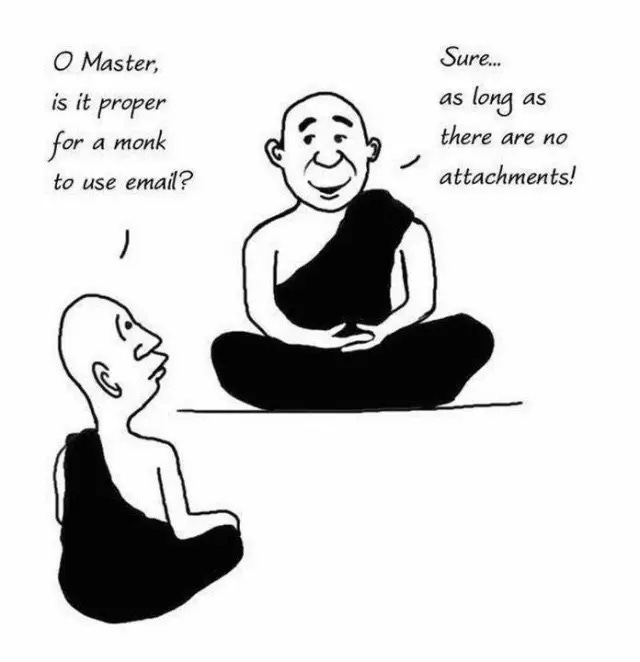
Attachment: The Most Perplexing Concept in Spirituality
It’s about navigating a vexing subtlety.
In all the years I’ve been writing about and studying the spiritual path, nothing has vexed me more than the idea behind attachment.
And it’s important. Why? Because attachment lies at the heart of our spiritual journey.
You know who thought so? The Buddha, one of the wisest beings to ever live, who said:
“The root of suffering is attachment.”
Sounds pretty significant to me.
The types of attachment
What is attachment? There are a few categories.
One would be attachment to things. Cars, a special coffee mug, Manolo Blahnik shoes, a painting hanging on your bedroom wall.
We become attached to ideas and positions. Democrat. Republican. Socialist. Stoic. Fiscal conservative but social progressive.
We attach ourselves to things being a certain way. I need a clean kitchen and bathroom before I go to bed. I need the exact right shade of white, out of the fifty that I’ve examined, to paint my kitchen.
Attachment to our kids
Then there’s the big Kahuna: People. We become attached to boyfriends, girlfriends, spouses, friends and the Grand Poobah of them all: Our children.
I think of attachments as things, ideas and people that I hold on to. The Buddhists would call it clinging.
The modern teacher most associated with attachment is Ram Dass, one of my favorite human beings. His is one of two pictures sitting on my desk, the other being his guru, Neem Karoli Baba.
Ram Dass is the one who taught me the ins and outs of attachment in various writings and lectures of his. He’s also the source of the perplexity of it all. How so?
What he’s saying is, “Don’t be attached to your Lexus SUV. Don’t be attached to your job. Don’t be attached to your French Poodle…” and on and on.
The perplexity of attachment
My first response upon hearing this is, as I’m sure it is with many of you, “So you’re asking me to go through life not caring about anything? What’s the point of living?”
Therein lies that perplexing subtlety from the article title. Because what he’s saying is that, of course we should care about things in life. We just shouldn’t become attached to them.
As Ram Dass put it,
“Our journey is about being more deeply involved in life, and yet less attached to it.”
Which leads to the central question on the whole concept: What’s the difference between non-attached caring-being deeply involved in life and attachment?
My Masters mug bites the dust
Here’s a small example from my life that will shed light. I went to the Masters golf tournament in Augusta, Georgia, in 2015, and had a blast. My brother and I bought tons of shirts, hats, etc., that can only be bought at the tournament. It’s some of the most valuable swag in all of sports.
One of those items was a beautiful mug with the Masters logo on it. It was my go-to mug for six years, the one I put in the freezer and used for my post-workout seltzer water with lemon or for a beer at dinner time.
One day I retrieved the mug from the freezer, put it on the counter, then proceeded to get my seltzer and lemon, something I’d done hundreds of times before.
But this time, the icy part on the bottom of the mug caused it to slide off the counter and smash into a hundred pieces. Bye, bye Masters mug.
My previous self would have been anguished over this because I’d have developed a strong attachment to it. The more spiritual me?
“Dang, my Masters mug broke. We had a good six years, my friend. Sorry to see you go. Life goes on.”
And that’s it. It was gone and I didn’t look back. That’s not to say that I was happy it broke. Far from it. I really liked that mug. I just never allowed an attachment to develop with this inanimate object that caused me to need it.
I cared about the mug, but I wasn’t attached to it.
The tough one comes when Ram Dass talks about attachment to our kids. Are parents not supposed to worry if their kid is struggling? It seems impossible.
When asked about this once, Ram Dass said,
“Attachment is attachment.”
Whether it’s a beer mug or a precious child, attachment isn’t good for our well-being.
Ego is at the center of it
Why? The answer lies in what forms these attachments in the first place. It’s one word. Any guesses?
Ego.
Sorry for being a broken record on this but all roads lead back to ego as the central player in the human drama.
Fortunately, Ram Dass teaches us that there’s a way to use attachment for growth. He said,
“A feeling of aversion or attachment toward something is your clue that there’s work to be done.”
What work? Letting go.
If you spill red wine on your favorite pair of white jeans and go into despair over it, notice that. Then relax, breathe and do your best to let go of that attachment.
If your son fails his math final (mine is studying in the kitchen right now for his!), relax and let go.
And know this: A parent is of far greater value to their kid when in a state of relaxed non-attachment than when they’re freaking out and only adding kindling to the fire.
Put another way: True love springs from a place of peaceful non-attachment, not from fear-based attachments.
The takeaway
It takes a lot of work to get to that state of peaceful non-attachment. But there is no more valuable work we can do.
As the Buddha said:
“The person who clings to nothing of the past, present and future, who has no attachment and holds on to nothing — that person, I call a Holy Person.”


The concept of "the glass is already broken" allows one to love so much more deeply and genuinely.